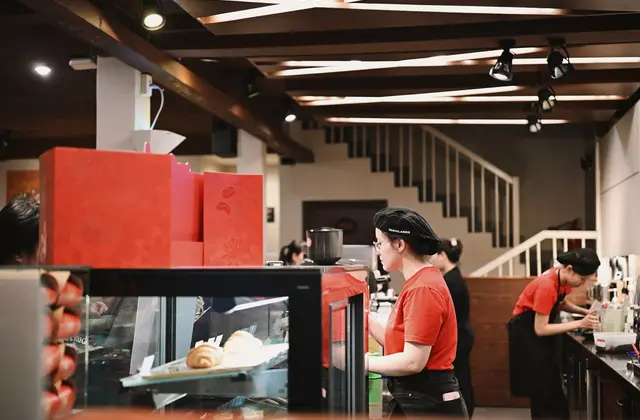

The specific challenges of retail and restaurant recruitment
Retail and restaurant hiring almost never pauses. One outlet loses two cashiers this week, another needs extra crew before a long holiday, and a newly opened store needs a full team in a short window. HR ends up reading a pile of near-identical applications while chasing needs that are always urgent.
The problem is rarely a shortage of applicants. The hard part is telling who can stand for hours, stay friendly with an upset customer, and actually show up on weekends. In F&B hiring, a candidate who looks great on paper can quit in week two because the shift schedule does not fit. That is why the criteria need to be set before the applications arrive.
Challenges
High turnover means hiring never finishes
Many frontline employees work temporarily while studying or waiting for another job. Every time someone leaves, HR starts over, so what you need is a screening flow that can be reused without being redesigned each time.
Plenty of applications, but nearly identical
A single cashier or crew vacancy can attract hundreds of applicants with similar backgrounds. Reading them one by one drains time, and important differences such as shift availability or home location are easy to miss in the pile.
Placements spread across many outlets
A strong applicant does not necessarily live near the outlet with the vacancy. Without tidy location and availability data, candidates get offered distant placements and decline, and HR loses time and candidates who were actually a good fit.
Demand spikes in peak seasons
Ahead of Ramadan, Lebaran, year-end, or a big promotion, staffing needs rise in a short time. Screening that is normally relaxed gets compressed, and the risk of hiring the wrong people grows with it.
The roles most often hired in retail and F&B
Each outlet role demands a different mix of service attitude, accuracy, stamina, and leadership. Holding every role to a single standard blurs the assessment and leads to poor placements.
- 1
Cashier
Assessed on accuracy when counting money, composure during long queues, honesty, and the ability to explain prices or promotions politely.
- 2
Sales associate
Assessed on friendliness, product knowledge, initiative in offering help without pushing, and neatness when arranging displays and keeping shelves stocked.
- 3
Barista
Assessed on consistent drink-making skill, speed at peak hours, a clean workstation, and the ability to chat easily with regular customers.
- 4
Kitchen and service crew
Assessed on readiness to work in a team, physical stamina, hygiene discipline, and willingness to follow recipe standards and serving order.
- 5
Store manager and area manager
Assessed on shift team leadership, daily operational control, accuracy in reading sales targets, and the ability to develop staff so they stay.
From a pile of CVs to a shortlist
Illustrated flow: CVs come in, are screened against your criteria, and only the most relevant candidates move on to the next stage.
The old way
- A vacancy is posted on several channels, hundreds of CVs and WhatsApp messages arrive, and the HR team or outlet heads read them manually one by one.
- Candidates are contacted individually to ask about home location, schedule, and expected salary, often repeatedly because the information is scattered across many chats.
- Initial interviews are scheduled at the outlet, and quite a few candidates do not show up or turn out not to fit the working hours on offer.
With TalentRank
- Define Custom Hiring Criteria for each position, for example shift availability, service experience, and distance to the outlet, as one rubric shared by every outlet.
- Upload many CVs at once to CV Screening AI, then review the ranking and candidate summaries scored against that position's criteria.
- Send WhatsApp Prescreening to collect early answers such as home location, schedule availability, and salary expectations before the next stage.
- Run AI Interview with your company's questions, then have the HR team review the answers, scores, and summaries before deciding who to invite to the outlet.
CV screening criteria for retail and F&B recruitment
Frontline CVs are usually short, so the most useful signals often sit in small details. The six criteria below work as a starting point, then adjust them to your outlet concept and operating hours.
| Criterion | Priority | Good signs in the CV | Worth asking about |
|---|---|---|---|
| Shift and weekend availability | High | The applicant states they are willing to work rotating shifts, holidays, and weekends, or their previous jobs were on similar hours. | Lists rigid working-hour conditions, is still studying with a heavy schedule and no explanation, or refuses national holidays. |
| Customer service experience | High | Has worked in a store, cafe, restaurant, or other role with direct customer contact, with a clear description of duties. | All experience is in roles without customer contact, and there is no convincing reason for moving into service. |
| Distance from home to the outlet | High | Lives near the outlet with the vacancy or has reasonable transport access for opening and closing hours. | Lives far away without their own vehicle, while shifts end late at night or start very early. |
| Work history and reasons for moving | Medium | Changes jobs for sensible reasons, such as a contract ending or an outlet closing, and has held at least one job for a reasonable length of time. | A repeated pattern of leaving within weeks without explanation, especially in roles that need initial training. |
| Accuracy with cash and stock | High | Has handled cash, counted stock, or prepared daily reports, and can explain how they make sure the numbers match. | Has never handled money or goods, or their work history includes cash shortages with no reasonable explanation. |
| Health documents and hygiene training | Medium | For F&B roles, the applicant is ready to present a health certificate or food hygiene training. Always check the latest requirements that apply in your region and company. | Refuses a health check or is unwilling to follow basic hygiene standards in food and beverage areas. |
Shift and weekend availability
HighGood signs in the CV: The applicant states they are willing to work rotating shifts, holidays, and weekends, or their previous jobs were on similar hours.
Worth asking about: Lists rigid working-hour conditions, is still studying with a heavy schedule and no explanation, or refuses national holidays.
Customer service experience
HighGood signs in the CV: Has worked in a store, cafe, restaurant, or other role with direct customer contact, with a clear description of duties.
Worth asking about: All experience is in roles without customer contact, and there is no convincing reason for moving into service.
Distance from home to the outlet
HighGood signs in the CV: Lives near the outlet with the vacancy or has reasonable transport access for opening and closing hours.
Worth asking about: Lives far away without their own vehicle, while shifts end late at night or start very early.
Work history and reasons for moving
MediumGood signs in the CV: Changes jobs for sensible reasons, such as a contract ending or an outlet closing, and has held at least one job for a reasonable length of time.
Worth asking about: A repeated pattern of leaving within weeks without explanation, especially in roles that need initial training.
Accuracy with cash and stock
HighGood signs in the CV: Has handled cash, counted stock, or prepared daily reports, and can explain how they make sure the numbers match.
Worth asking about: Has never handled money or goods, or their work history includes cash shortages with no reasonable explanation.
Health documents and hygiene training
MediumGood signs in the CV: For F&B roles, the applicant is ready to present a health certificate or food hygiene training. Always check the latest requirements that apply in your region and company.
Worth asking about: Refuses a health check or is unwilling to follow basic hygiene standards in food and beverage areas.
Sample interview questions for retail and restaurant staff
These questions probe real behavior rather than rehearsed answers. Group them by theme so interviewers at every outlet assess in the same way and the results can be compared.
Service attitude
1.Tell me about a time you served an angry customer. What did you do first?
A good answer: Shows whether the candidate listens first or gets defensive, and how calm they stay under pressure.
2.What do you do when a customer asks about something you do not know?
A good answer: Tests honesty and willingness to find the answer, rather than guessing to look knowledgeable.
3.In your view, what makes customers want to come back to a store or cafe?
A good answer: Reveals how the candidate understands service: whether it is only about price or also about attitude and cleanliness.
Working hours and shift readiness
4.Which part of the weekly schedule is hardest for you, and how do you manage it?
A good answer: Draws out honest limits on availability before placement, so there are fewer surprises in the first week.
5.Are you willing to work weekends and national holidays? Are there any conditions?
A good answer: Confirms commitment to peak hours and surfaces conditions that are not written on the CV.
6.How long is your commute to this outlet, and how will you get home when the shift closes?
A good answer: Tests whether the placement is practical, especially for night shifts and very early starts.
Accuracy and situations on the floor
7.If the cash drawer is short at the end of your shift, what steps do you take?
A good answer: Assesses honesty and the habit of tracing discrepancies, rather than covering them up or blaming a colleague.
8.How do you act when the outlet is packed and a teammate on your shift does not show up?
A good answer: Shows initiative, teamwork, and the ability to set priorities when conditions are not ideal.
9.Have you ever seen a colleague break a workplace rule? What did you do?
A good answer: Probes integrity and how the candidate handles violations in a workplace that deals with money and goods.
Common mistakes
- 01
Weighing appearance more than behavior
First impressions do matter in retail, but appearance does not guarantee resilience with difficult customers. Use situational questions and a written rubric so the assessment does not depend on the interviewer's taste.
- 02
Leaving the schedule discussion until after the offer
Working hours, night shifts, and weekends should be explained early in the process. Candidates who only learn about them after accepting tend to quit quickly, and the outlet is short-staffed again.
- 03
Using the same standard for every position
The criteria for a cashier, a barista, and a store manager are very different. One generic list makes managerial candidates too easy to pass and crew candidates too hard.
- 04
Not recording why candidates were rejected or withdrew
Without records, the patterns behind turnover stay invisible. Reasons such as distance, schedule, or pay need to be collected so the next vacancy can be designed more accurately.
- 05
Relying on the outlet head alone for early screening
Outlet heads are already busy serving customers at peak hours, so early screening often gets rushed. Separate initial screening from the final interview at the outlet so both get enough attention.
Scenario
Company
A cafe and bakery chain with a dozen or so outlets across several cities that regularly hires crew, cashiers, and baristas.
Situation
Ahead of the holiday season, several outlets need extra staff at the same time while the HR team is only a few people. Applications arrive through many channels, and many omit both schedule and home location.
Expected outcome
Outlet heads only interview candidates whose schedule and location are already confirmed, leaving more of their time for serving customers at peak hours.
- 1HR sets a rubric per position, weighting shift availability, service experience, and distance to the outlet.
- 2All incoming CVs are uploaded at once and ranked against the rubric, then HR reviews the summaries of the top candidates.
- 3Selected candidates receive WhatsApp Prescreening to confirm home location, schedule, and salary expectations.
- 4Those who pass take the AI Interview, then HR reviews scores and summaries before inviting them to the nearest outlet.
What you get
- Candidate ranking per position and per outlet
- CV summaries that outlet heads can read easily
- AI Interview answers and scores per criterion
- Home location and schedule availability data from WhatsApp